I remember a line in the movie, The Dark Knight, where Batman says you either die a hero or live long enough to become the villain. Or something like that. I've always loved that idea for a novel plot.
In my upcoming release, First Dragon, war is spreading across the land of Morbunda. Long ago in the history of Morbunda, a war was fought that resulted in great loss of human life and the apparent annihilation of all dragons. It took generations for civilization to recover. Now war is coming to Morbunda again, and this time the aggressors are the former heroes of the first war. Just like Batman said would happen!
In most fantasy novels, war is part of the plot line. In the best novels, each side in the war believes they are fighting for what is right and best unless they're purely evil. I hope the readers of First Dragon see the issues driving both sides of the new war. And I hope lots of people read First Dragon when it's released this Friday from Crescent Moon Press.
Do you agree with Batman? Do you think wars happen in cycles? Have you read any good fantasy novels where you couldn't really tell who the good guys are and who the bad guys are?
I might be a little late getting around to your blogs today. I'm helping my son move across the country this week.

Wednesday, October 30, 2013


Monday, October 28, 2013
One of a Kind
This Friday, my newest epic fantasy, First Dragon, will be released from Crescent Moon Press. I'm beyond excited. I wrote this book almost two years ago, polished and found a home for it last year. At the time, I wasn't aware of many dragon books on the market. Now that my book is about to hit the bookstores, I see dragon books everywhere.
I'm hoping readers will appreciate my unique take on dragons, dragon magic and dragon relationships with humans. At the same time, I wanted to keep some commonly accepted characteristics of dragons as part of my protagonist. Dragons are arrogant creatures, proud and certain of their superiority to men. Dragons are cruel and clever, able to trick humans. Dragons know of war and take advantage of man's greed to further their own agendas.
So how do I make my dragon protagonist different? Kerik didn't know he was a dragon as a child. He grew up among loving friends until his heritage was discovered. Kerik battles his greedy, arrogant nature but it's always there. He's secretive and dangerous. Kerik is constantly torn between what his nature drives him to do and what he should do to help his embattled human friends. He truly is a dark hero.
Can you think of a fantasy character that an author added a unique twist to? Do you have a favorite dragon character in a movie or book? Have you visited the IWSG blog today to sample some sage words?
I'm hoping readers will appreciate my unique take on dragons, dragon magic and dragon relationships with humans. At the same time, I wanted to keep some commonly accepted characteristics of dragons as part of my protagonist. Dragons are arrogant creatures, proud and certain of their superiority to men. Dragons are cruel and clever, able to trick humans. Dragons know of war and take advantage of man's greed to further their own agendas.
So how do I make my dragon protagonist different? Kerik didn't know he was a dragon as a child. He grew up among loving friends until his heritage was discovered. Kerik battles his greedy, arrogant nature but it's always there. He's secretive and dangerous. Kerik is constantly torn between what his nature drives him to do and what he should do to help his embattled human friends. He truly is a dark hero.
Can you think of a fantasy character that an author added a unique twist to? Do you have a favorite dragon character in a movie or book? Have you visited the IWSG blog today to sample some sage words?
Friday, October 25, 2013
So You Call Yourself a Writer
I've mentioned before that I'm not above cruising the writing magazines in the bookstore and skimming articles before I decide to invest. There are lots of them out there, just check out the links on the Publication Page of IWSG. But I also gather ideas for my blog during those peeks between the covers.
Recently I skimmed an article about a man who had quit his teaching job, took off for a remote village in Europe and sat down to write the next bestseller. Should you quit your day job? Check out what others say about quitting the bill paying job.
I don't remember the genre or even the author's name, but he lived in a falling down cottage for six months until his money ran out. He was so proud of the 100 pages he wrote during that time, what he consider a great start to his book. Really!
Now that I'm a full time writer, I spend lots more hours in my comfy office than when I held my full time teaching job. I still have lots of things that keep my busy. We have a six bedroom house and lots of outside area that needs care. My husband and I, now that our children have or are preparing to take flight from the nest, are fixing up here and there in preparation of selling the homestead. I'm glad I have time for that and to visit my elderly mother, but I still consider myself to have a full time job. Would I feel that way if I wrote one hundred pages in six months?
If one is working at a full time job, writing in the evenings and on weekends, one hundred pages could be pretty good. If one is in the midst of child rearing, one hundred pages is quite an accomplishment. If you think you're busy when they're infants, wait until the teen years. But if I left everything behind and had nothing to do except feed myself, do occasional laundry and walk on the seaside, would I be thrilled with one hundred pages in six months? I don't think so.
Are writing retreats good ways to get the creative juices flowing? Is surrounding oneself with nothing but the book the way to get that novel done? I'm sure it is for some people. I've read other stories of writers who retreated to quiet and isolation when creating their jewels. As NaNo approaches for many people, not me, I'm sure lots of the participants will be pounding the keyboards at lunch breaks, while fixing dinner, in between loads of laundry and perhaps even while working on the treadmill. And some of them will produce jewels, maybe still unpolished, but rich just the same.
If you had the chance to isolate yourself and write without any distractions, how much would you expect yourself to produce? Have you ever taken a writing retreat? Where did you go and how much did you get done? Have you ever considered taking the plunge, quitting the day job and trying to make it as a writer?
Recently I skimmed an article about a man who had quit his teaching job, took off for a remote village in Europe and sat down to write the next bestseller. Should you quit your day job? Check out what others say about quitting the bill paying job.
I don't remember the genre or even the author's name, but he lived in a falling down cottage for six months until his money ran out. He was so proud of the 100 pages he wrote during that time, what he consider a great start to his book. Really!
Now that I'm a full time writer, I spend lots more hours in my comfy office than when I held my full time teaching job. I still have lots of things that keep my busy. We have a six bedroom house and lots of outside area that needs care. My husband and I, now that our children have or are preparing to take flight from the nest, are fixing up here and there in preparation of selling the homestead. I'm glad I have time for that and to visit my elderly mother, but I still consider myself to have a full time job. Would I feel that way if I wrote one hundred pages in six months?
If one is working at a full time job, writing in the evenings and on weekends, one hundred pages could be pretty good. If one is in the midst of child rearing, one hundred pages is quite an accomplishment. If you think you're busy when they're infants, wait until the teen years. But if I left everything behind and had nothing to do except feed myself, do occasional laundry and walk on the seaside, would I be thrilled with one hundred pages in six months? I don't think so.
Are writing retreats good ways to get the creative juices flowing? Is surrounding oneself with nothing but the book the way to get that novel done? I'm sure it is for some people. I've read other stories of writers who retreated to quiet and isolation when creating their jewels. As NaNo approaches for many people, not me, I'm sure lots of the participants will be pounding the keyboards at lunch breaks, while fixing dinner, in between loads of laundry and perhaps even while working on the treadmill. And some of them will produce jewels, maybe still unpolished, but rich just the same.
If you had the chance to isolate yourself and write without any distractions, how much would you expect yourself to produce? Have you ever taken a writing retreat? Where did you go and how much did you get done? Have you ever considered taking the plunge, quitting the day job and trying to make it as a writer?
Wednesday, October 23, 2013
What Makes a Monster?
I'm not a big fan of Halloween. We lived miles from anyone when I was growing up and we never went trick or treating. Not even once. As a mother, I never gave my children candy when they were little, and none of them developed a taste for it. Still I took them around the block to trick or treat but most of the candy ended up at school, given to my students. Costumes were always a chore for me, probably because I have no enthusiasm for the holiday. I played the good mother and tried to make sure my kids found costumes they'd like. They always wanted to be heroes, nary a monster or goblin among them. Ninjas, Power Rangers, Batman, Superman, whomever the hero de jour.

Zombies are a popular choice for monster apparel in recent years and I expect we'll have some of them knocking on our door next week. And other monsters. As I prepare for the release of my fantasy novel, First Dragon, I've taken a bit of time to think about what really makes a monster. The second novel in The Morbunda Saga delves into that question as the characters in the series are forced to fight battles that seem to have no winner and sometimes no clear sides of good and evil.
What monsters are scariest. Physically imposing predators, without mercy for their prey? Beastly killers with no capacity for humane mercy? A being with unstoppable magical powers? A technology with cold, superior intelligence and no warmth of emotions? Are monsters ugly or perhaps possessed of a beautiful exterior hiding the evil within? Is a great white shark a monster because he kills without mercy, driven by instinct? Or is a human killing with forethought and planning the monster? Is what drives the monster the measure of his evil?
In First Dragon, monsters of many types make an appearance. Some know they are monsters and others fear that they are. Some behave as monsters and believe themselves heroic.
I think I would find a magician who could do mind control to be a very, very frightening thing. What kind of monster do you think would be scariest? What Halloween costume was your favorite or your children's favorite? Do you have a favorite monster movie?
Zombies are a popular choice for monster apparel in recent years and I expect we'll have some of them knocking on our door next week. And other monsters. As I prepare for the release of my fantasy novel, First Dragon, I've taken a bit of time to think about what really makes a monster. The second novel in The Morbunda Saga delves into that question as the characters in the series are forced to fight battles that seem to have no winner and sometimes no clear sides of good and evil.
What monsters are scariest. Physically imposing predators, without mercy for their prey? Beastly killers with no capacity for humane mercy? A being with unstoppable magical powers? A technology with cold, superior intelligence and no warmth of emotions? Are monsters ugly or perhaps possessed of a beautiful exterior hiding the evil within? Is a great white shark a monster because he kills without mercy, driven by instinct? Or is a human killing with forethought and planning the monster? Is what drives the monster the measure of his evil?
In First Dragon, monsters of many types make an appearance. Some know they are monsters and others fear that they are. Some behave as monsters and believe themselves heroic.
I think I would find a magician who could do mind control to be a very, very frightening thing. What kind of monster do you think would be scariest? What Halloween costume was your favorite or your children's favorite? Do you have a favorite monster movie?
Monday, October 21, 2013
Inspiration and Comfort
I opened my email yesterday to a big surprise. The ARC of my upcoming release, First Dragon, was in my inbox for a last read through before its November first release from Crescent Moon Press. I've been expecting it, but not on a Sunday.
I'd planned a trip to the local BAM to relax in the café, plan my blogs for the week and work on War Dragon, book #2 in The Morbunda Saga. Instead, I had an ARC to read. I warned the my husband and son not to bother me as I settled myself at my writing desk and went to work. The two men headed out to a local sports bar to watch football and leave me in peace.
And peaceful it was. I couldn't help but notice as I stood up to walk around every so often or to refill my coffee all the things I gathered around me in my writing for comfort. Things given to me by my supportive family. Some assist me and some just make me smile and keep on working.
My oldest son bought me this cool ceramic jar when he was a student at Gettysburg College. I use it to keep paper clips of all sizes and styles.

My daughter made me this ceramic cup I use to keep my glasses in. Yes, I have way too many.

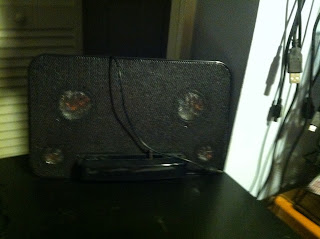
My youngest son gave me this little speaker set for my iPod so I can listen to some tunes when I write.
My daughter gave me this really cool feather quill that I still can't write with, at least not very well.

My middle son and my daughter gave me these cards, one inspired by Dr. Who and the Wonder Woman in thanks for doing so much for them. I keep those where I can see them all the time.

Besides the comfort of their gifts surrounding me, the ARC itself inspired me to work for ten straight hours. The font selected by the editors for the chapter headings and page headings was so cool, I can't wait to share with everyone next week. The work the editorial staff did on the book was top notch. It was exciting.
Other things inspiring me everyday I sit at the computer are the people I know in the blogging community. Two great places to share and receive wisdom are the IWSG blog and the IWSG Facebook Page.
What things give you comfort in your workspace? Is your family supportive like mine? Have you visited IWSG today? Is your desk home to some beloved things or do you keep it bare and clear? What is the longest you've spent at your writing desk in one day?
I'd planned a trip to the local BAM to relax in the café, plan my blogs for the week and work on War Dragon, book #2 in The Morbunda Saga. Instead, I had an ARC to read. I warned the my husband and son not to bother me as I settled myself at my writing desk and went to work. The two men headed out to a local sports bar to watch football and leave me in peace.
And peaceful it was. I couldn't help but notice as I stood up to walk around every so often or to refill my coffee all the things I gathered around me in my writing for comfort. Things given to me by my supportive family. Some assist me and some just make me smile and keep on working.
My oldest son bought me this cool ceramic jar when he was a student at Gettysburg College. I use it to keep paper clips of all sizes and styles.

My daughter made me this ceramic cup I use to keep my glasses in. Yes, I have way too many.

My youngest son gave me this little speaker set for my iPod so I can listen to some tunes when I write.

My daughter gave me this really cool feather quill that I still can't write with, at least not very well.

My middle son and my daughter gave me these cards, one inspired by Dr. Who and the Wonder Woman in thanks for doing so much for them. I keep those where I can see them all the time.

Besides the comfort of their gifts surrounding me, the ARC itself inspired me to work for ten straight hours. The font selected by the editors for the chapter headings and page headings was so cool, I can't wait to share with everyone next week. The work the editorial staff did on the book was top notch. It was exciting.
Other things inspiring me everyday I sit at the computer are the people I know in the blogging community. Two great places to share and receive wisdom are the IWSG blog and the IWSG Facebook Page.
What things give you comfort in your workspace? Is your family supportive like mine? Have you visited IWSG today? Is your desk home to some beloved things or do you keep it bare and clear? What is the longest you've spent at your writing desk in one day?
Friday, October 18, 2013
Readers Have Feelings Too
It would be difficult to find a person who would argue that reading is bad for a person, at least in the civilized parts of the world. I know there are parts of planet Earth where certain persons prefer the population remain illiterate and ignorant. But most people know that reading is a good thing.
Most parents know they should read to their children from an early age, perhaps even before birth. Some studies say it doesn't even matter that much what you read to them. As children get older and become full grown adults in love with reading, they select what they want to read. The benefits are life-long. I came across, thanks to an RWA newsletter, another side benefit of reading.
This results of this study, published in The Atlantic, link what people read with their social abilities. Things such as skills in reading emotions in other people and sensitivity to other people are linked to what they read. Readers of fiction are more emotionally sensitive than readers of nonfiction and readers of romance are the most likely to read other people correctly.
The study does pose the question of the chicken and the egg. Do sensitive people read more fiction or romance, or do they become more sensitive because they read fiction?
What do you think, chicken or egg? Did your parents read to you or did you read to your children? Do you agree with The Atlantic?
Most parents know they should read to their children from an early age, perhaps even before birth. Some studies say it doesn't even matter that much what you read to them. As children get older and become full grown adults in love with reading, they select what they want to read. The benefits are life-long. I came across, thanks to an RWA newsletter, another side benefit of reading.
This results of this study, published in The Atlantic, link what people read with their social abilities. Things such as skills in reading emotions in other people and sensitivity to other people are linked to what they read. Readers of fiction are more emotionally sensitive than readers of nonfiction and readers of romance are the most likely to read other people correctly.
The study does pose the question of the chicken and the egg. Do sensitive people read more fiction or romance, or do they become more sensitive because they read fiction?
What do you think, chicken or egg? Did your parents read to you or did you read to your children? Do you agree with The Atlantic?
Wednesday, October 16, 2013
A Dark, Dark Night On a Dark, Dark Street
When my boys were little they asked my husband to read and reread this little book. I wish I still had it. It was about a father and son skeleton going out on the town. I can only remember the start, "It was a dark, dark night on a dark, dark street in a dark, dark town..." You get the idea. My husband would read it to them in his dark, dark voice.
I always think of that book for some reason when people talk about the dark moment in their novel. Movies and TV shows have dark moment too. You know that point in the story when despair and desperation sets in. Everything that could go wrong does and maybe a little bit more. There's no way out for the good guys. The best dark moments have physical and emotional dangers ready to pull the protagonists into the abyss of failure. The dark moment can only be conquered only by the hero or heroine making a decision or taking a chance that requires sacrifice of some sort.
I'm in the middle of writing the dark moment in my current WIP, War Dragon, the sequel to First Dragon. In a series with an ongoing saga like my current works, there's a dark moment in each book. But each book also builds toward the greater dark moment of the series. The good guys are losing ground in each book. Which brings me to the next point.
The main characters have to be tortured, hurt, trapped torn apart or something equally terrible to create a compelling dark moment. I'm cringing as I type in the horrors visiting my characters in the next 15K of manuscript. They won't all survive. Now that's dark.
Do you have fun writing the dark moment or does it hurt you to hurt your characters? Have you ever watched a TV show and guessed at what time the dark moment will occur? Usually about 45-50 minutes in, I think. Have you read books where the dark moment was too easily solved?
I always think of that book for some reason when people talk about the dark moment in their novel. Movies and TV shows have dark moment too. You know that point in the story when despair and desperation sets in. Everything that could go wrong does and maybe a little bit more. There's no way out for the good guys. The best dark moments have physical and emotional dangers ready to pull the protagonists into the abyss of failure. The dark moment can only be conquered only by the hero or heroine making a decision or taking a chance that requires sacrifice of some sort.
I'm in the middle of writing the dark moment in my current WIP, War Dragon, the sequel to First Dragon. In a series with an ongoing saga like my current works, there's a dark moment in each book. But each book also builds toward the greater dark moment of the series. The good guys are losing ground in each book. Which brings me to the next point.
The main characters have to be tortured, hurt, trapped torn apart or something equally terrible to create a compelling dark moment. I'm cringing as I type in the horrors visiting my characters in the next 15K of manuscript. They won't all survive. Now that's dark.
Do you have fun writing the dark moment or does it hurt you to hurt your characters? Have you ever watched a TV show and guessed at what time the dark moment will occur? Usually about 45-50 minutes in, I think. Have you read books where the dark moment was too easily solved?
Subscribe to:
Posts (Atom)