One of the tidbits I jotted down at the recent Pennwriters Conference was something Meredith Mileti, our luncheon keynote speaker said. She proposed that many writers are unitaskers. Since I am entirely the opposite, I had to explore this a little.
As I've mentioned on this blog many times, I always have music or even a video playing in the background when I write. I'm watching a TV show on demand as I write this. As a busy mother, I learned to multitask as a way to survive and make sure everything ran smoothly. That carried over to my writing. But Meredith sounded so sure of herself I had searched out some articles on the subject. Here is one from Forbes and another interesting one from Naukri, a career help site.
Most of the articles I found were related to working in office like places rather than writing at home but the advice was the same. But the advice is solid for working at home also. I found it very interesting and am going to try unitasking more, especially when I feel like I'm stuck on a scene. The point made in a few of the articles that stuck with me is that multitasking is really nothing of the sort. What your mind is actually doing is switching quickly from task to task and giving none its due attention.
There were a few ideas shared to help you unitask and again one stuck with me. Uncluttering your workspace. Those stacks of reminders of other things you need to address will on distract you from what you're working on. I realized this is so true for me. I'm going to clean up my desk this weekend.
Another point I learned from reading about unitaskers is that sometimes I am one. When I do edits, I do that without the music or video noise. At least I'm doing something right.
So do you unitask or multitask when you write? Do you agree with what the articles say about the inefficiency of multitasking? When do you always unitask at an activity? Do you agree with Meredith that many writers are unitaskers?

Friday, June 6, 2014


Wednesday, June 4, 2014
IWSG: June Version
Thanks to the wonderful Alex J. Cavanaugh, a huge group of writers share their wisdom, woes and offer encouragement on the first Wednesday of very month. Alex started the group and a few months ago took it even further by being the driving force behind the Insecure Writer's Support Group blog. You can find the entire list of participants there. Visit and share with others navigating the same waters as you are.
Summer has nearly arrived and with it a lot of people are heading for vacation. Even if they aren't traveling, they're taking some time off from blogging. They have many reasons for blogging vacations. One blogger I know is moving. One is dealing with some health issues. A few are going away and either putting the technology to sleep for a while or do not have access to it. Some need to spend their hours working on they latest project.
Bloggers taking a break from blogging usually warn their readers rather than just disappear. And many still visit and comment on other blogs, they just don't have time to prepare their own. Sometimes they apologize to their followers for their upcoming absence. But they shouldn't.
This group is about writers. And writers need time to write and blogging can take away from that. Writers just like other workers, need time off from their career. Sometimes work must come second to family needs, recuperation, and other adult responsibilities. Take that blogging break if you need it and no need to explain to those of us in this group.
Have you taken a blogging vacation and why? Did you find it freed up time you needed for other things? Are you a member of the IWSG Facebook Page? Check out the entire list of bloggers to visit today at IWSG blog.
Summer has nearly arrived and with it a lot of people are heading for vacation. Even if they aren't traveling, they're taking some time off from blogging. They have many reasons for blogging vacations. One blogger I know is moving. One is dealing with some health issues. A few are going away and either putting the technology to sleep for a while or do not have access to it. Some need to spend their hours working on they latest project.
Bloggers taking a break from blogging usually warn their readers rather than just disappear. And many still visit and comment on other blogs, they just don't have time to prepare their own. Sometimes they apologize to their followers for their upcoming absence. But they shouldn't.
This group is about writers. And writers need time to write and blogging can take away from that. Writers just like other workers, need time off from their career. Sometimes work must come second to family needs, recuperation, and other adult responsibilities. Take that blogging break if you need it and no need to explain to those of us in this group.
Have you taken a blogging vacation and why? Did you find it freed up time you needed for other things? Are you a member of the IWSG Facebook Page? Check out the entire list of bloggers to visit today at IWSG blog.
Monday, June 2, 2014
Pennwriters Agent Panel
In my continuing effort to share some of what I heard at the annual Pennwriters Conference two weeks ago, I'm going to share some information I picked up from the agents' panel presentation. I'll link each agent to their agency or website and share what they're in search of and for some of them, their pet peeve in pitches or query letters.
Katie Shea Boutillier of the Donald Maass Literary Agency is seeking YA and women's fiction. She describes women's fiction as a book that would appeal to a book club.
Maria Lamba of the Jennifer DeChiara Literary Agency would like to receive MG-YA and general fiction. She asks that authors don't label romance as women's fiction.
Bob Podrasky of the Stuart Agency like general fiction and most genre fiction. He also seeks nonfiction. He suggests you compare your books to published authors to help them categorize your book. Another way to do so is to decide what author you would ask to give a quote for your jacket cover.
Jessica Regel of Foundry Literary and Media seeks all genres of MG and YA. She's also interested in some adult fiction, especially books that straddle the line between literary and commercial works.
Bridget Smith of the Dunham Literary likes SF/F and women's literary novels. She doesn't want to see a query that calls the main character 'normal.'
Paige Wheeler of the Folia Literary Management is seeking YA, MG, women's fiction, romance and suspense. In a pitch or query, mention other clients you compare to. She emphasizes the importance of brick and mortar stores in offering discoverability. Her least favorite word to see in an author's writing is 'drug' in place of dragged.
Peter Knapp from the Park Literary Group wants to see MG/YA, thrillers and mysteries. He suggests you try for that interesting one-liner for a pitch session or a query.
Jessica Sinsheimer of the Sarah Jane Freymann Agency seeks YA and women's fiction. She hates the phrase, 'turned her world upside down.'
Roseanne Wells, also of the Jennifer DeChiara Literary Agency wants SF/F, literary, mystery, and nonfiction.
Jordy Albert of The Booker Albert Literary Agency is seeing romance. She detests books that start with someone waking up.
There is a nice list of agents. As you can see, women's fiction is very popular. A number of the agents mentioned the statistic of how women are the leading book consumers.
Did you learn anything useful from the above agents? See any you would like to work with? Does it surprise you which genres they are most interested in? Do you have an agent or seek one?
Katie Shea Boutillier of the Donald Maass Literary Agency is seeking YA and women's fiction. She describes women's fiction as a book that would appeal to a book club.
Maria Lamba of the Jennifer DeChiara Literary Agency would like to receive MG-YA and general fiction. She asks that authors don't label romance as women's fiction.
Bob Podrasky of the Stuart Agency like general fiction and most genre fiction. He also seeks nonfiction. He suggests you compare your books to published authors to help them categorize your book. Another way to do so is to decide what author you would ask to give a quote for your jacket cover.
Jessica Regel of Foundry Literary and Media seeks all genres of MG and YA. She's also interested in some adult fiction, especially books that straddle the line between literary and commercial works.
Bridget Smith of the Dunham Literary likes SF/F and women's literary novels. She doesn't want to see a query that calls the main character 'normal.'
Paige Wheeler of the Folia Literary Management is seeking YA, MG, women's fiction, romance and suspense. In a pitch or query, mention other clients you compare to. She emphasizes the importance of brick and mortar stores in offering discoverability. Her least favorite word to see in an author's writing is 'drug' in place of dragged.
Peter Knapp from the Park Literary Group wants to see MG/YA, thrillers and mysteries. He suggests you try for that interesting one-liner for a pitch session or a query.
Jessica Sinsheimer of the Sarah Jane Freymann Agency seeks YA and women's fiction. She hates the phrase, 'turned her world upside down.'
Roseanne Wells, also of the Jennifer DeChiara Literary Agency wants SF/F, literary, mystery, and nonfiction.
Jordy Albert of The Booker Albert Literary Agency is seeing romance. She detests books that start with someone waking up.
There is a nice list of agents. As you can see, women's fiction is very popular. A number of the agents mentioned the statistic of how women are the leading book consumers.
Did you learn anything useful from the above agents? See any you would like to work with? Does it surprise you which genres they are most interested in? Do you have an agent or seek one?
Wednesday, May 28, 2014
Advanced Social Media
First of all, I'm not even close to an expert on social media. But at the recent Pennwriters Conference, I attended a workshop titled Advanced Social Media presented by Don Lafferty. I'm going to sum up just a fraction of what Don shared but if you visit his website you'll find lots more.
Don is a HUGE proponent of Facebook advertising. He shared some numbers about 'Likes' on your Facebook author page. It seems around 1,000 Likes is a milestone for a dramatic increase in web traffic coming from FB to your site. He said one of the most important things you can do is use FB to gather emails.
Despite Don's big push for spending money on paid Facebook advertising, he emphasized that email is still the leading and most powerful marketing tool. Getting people to sign up for email alerts and newsletters should be one of your goals.
Don also gave some advice about websites. He said to include a books page, an events page and of course, a short bio. And try to have everything important above the scroll. Again use your website or blog to entice readers to sign up for those emails.
Don't also suggested you repeat all Facebook posts on Google+. Google doesn't search FB but it loves all the content on Google+.
Don put forth a way to calculate how much money you should be spending a month on advertising. I think I dropped my pencil when I heard his estimate. It was way out of my budget.
Do you pay for Facebook advertising? Has it worked? Do you have an email list of readers? Do you use Google+? Want to like my Facebook page? I'm a long way from that 1,000 mark.
I'll be out of town on Friday so I'm not posting that day but I'll be around to visit.
Don is a HUGE proponent of Facebook advertising. He shared some numbers about 'Likes' on your Facebook author page. It seems around 1,000 Likes is a milestone for a dramatic increase in web traffic coming from FB to your site. He said one of the most important things you can do is use FB to gather emails.
Despite Don's big push for spending money on paid Facebook advertising, he emphasized that email is still the leading and most powerful marketing tool. Getting people to sign up for email alerts and newsletters should be one of your goals.
Don also gave some advice about websites. He said to include a books page, an events page and of course, a short bio. And try to have everything important above the scroll. Again use your website or blog to entice readers to sign up for those emails.
Don't also suggested you repeat all Facebook posts on Google+. Google doesn't search FB but it loves all the content on Google+.
Don put forth a way to calculate how much money you should be spending a month on advertising. I think I dropped my pencil when I heard his estimate. It was way out of my budget.
Do you pay for Facebook advertising? Has it worked? Do you have an email list of readers? Do you use Google+? Want to like my Facebook page? I'm a long way from that 1,000 mark.
I'll be out of town on Friday so I'm not posting that day but I'll be around to visit.
Monday, May 26, 2014
In Our Memories Today
I know many people use this day to have cookouts, family gatherings and perhaps even take a vacation. And why not? Hardworking people deserve those relaxing times. But I always feel sad on this day.
Yesterday was my daughter's twentieth birthday. We no longer have any teenagers in our family. This year also marks 20 years since my father passed away. He was a WWII vet, one of those who went overseas to defend his country.
Like so many men of that era, he'd never traveled more than twenty miles from the house where he was born before he signed up for the army. His older brother had left before him and my dad enlisted as soon as he was old enough. He dropped out of school, leaving after the tenth grade. Though labeled a sharpshooter after arms training, my father was never tasked to be a sniper. Something I'm grateful for but he saw enough terrible things to last a lifetime.
That wonderful man married my mother before he left for overseas and then came home and fathered seven children. He worked 16-18 hours a day for nearly forty years, putting us through college and being a great father and example of what a man should be. Today, I always spend the day thinking of him and missing him. He died a few months before my daughter was born and never met her. I know he would be proud of her.
Each day when I read or hear of another armed services member dying in the service to their country, I think of the hole left in the lives of those they left behind. I pray they know others mourn with them. Thank you to those that serve and have served. May you be safe and always appreciated.
Is this day a celebration holiday for you or a day filled with memories? Did you attend a parade or memorial ceremony? Do you know any veterans?
Yesterday was my daughter's twentieth birthday. We no longer have any teenagers in our family. This year also marks 20 years since my father passed away. He was a WWII vet, one of those who went overseas to defend his country.
Like so many men of that era, he'd never traveled more than twenty miles from the house where he was born before he signed up for the army. His older brother had left before him and my dad enlisted as soon as he was old enough. He dropped out of school, leaving after the tenth grade. Though labeled a sharpshooter after arms training, my father was never tasked to be a sniper. Something I'm grateful for but he saw enough terrible things to last a lifetime.
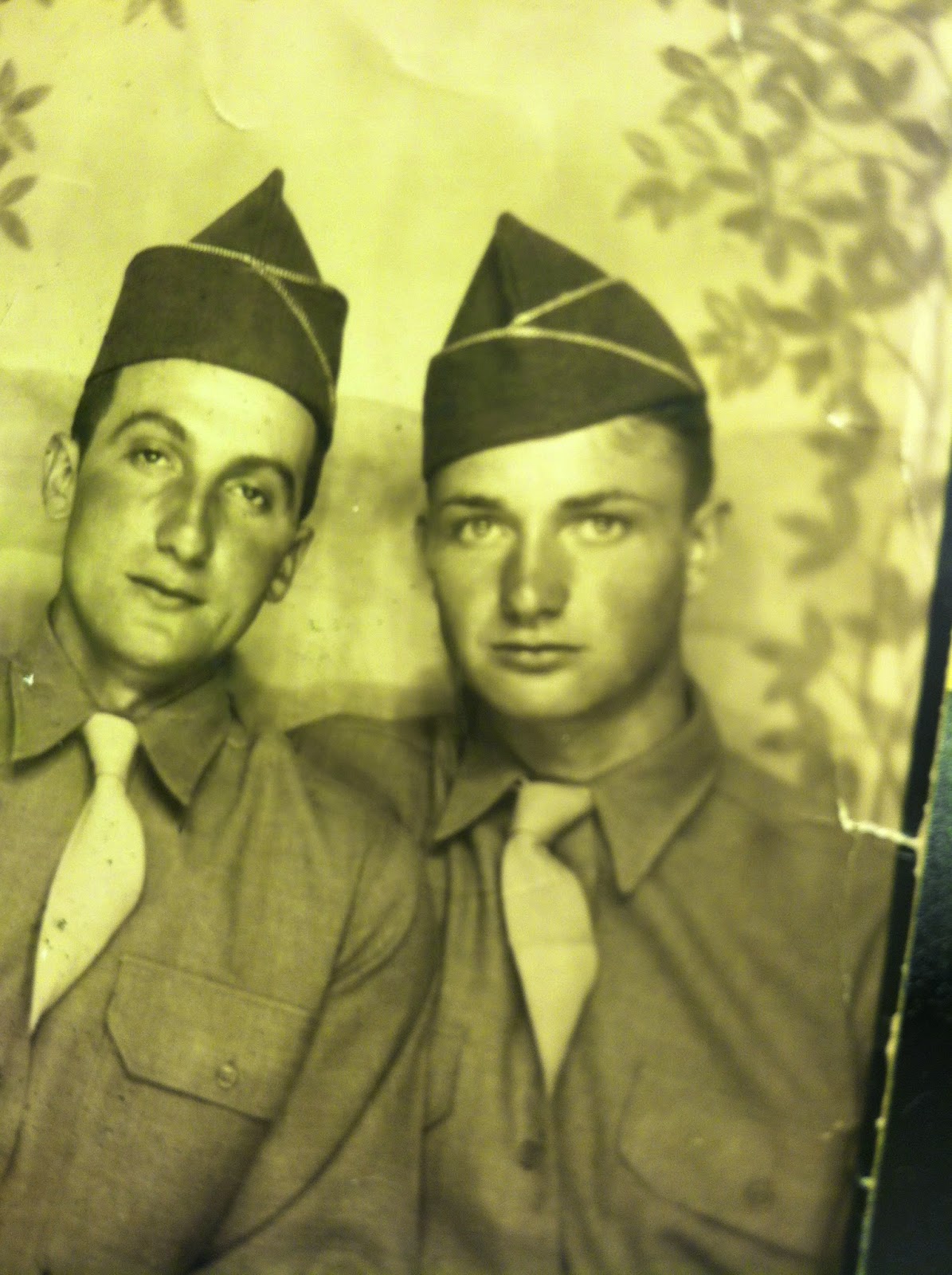 |
| My dad is the handsome guy on the right |
That wonderful man married my mother before he left for overseas and then came home and fathered seven children. He worked 16-18 hours a day for nearly forty years, putting us through college and being a great father and example of what a man should be. Today, I always spend the day thinking of him and missing him. He died a few months before my daughter was born and never met her. I know he would be proud of her.
Each day when I read or hear of another armed services member dying in the service to their country, I think of the hole left in the lives of those they left behind. I pray they know others mourn with them. Thank you to those that serve and have served. May you be safe and always appreciated.
Is this day a celebration holiday for you or a day filled with memories? Did you attend a parade or memorial ceremony? Do you know any veterans?
Friday, May 23, 2014
5 Agent Insights
I'm continuing with sharing some of the tidbits I picked up when attending the Pennwriters conference. One session I attended, How to Succeed for Writers: Agent Insights and Tips, was led by Marie Lamba and Roseanne Wells, both of the Jennifer DeChiara Literary Agency. You'll notice I only have five things to share from the hour long presentation. Both agents were energetic and interesting speakers but in this workshop, they spent all their time talking and allowed little time for questions.
Here is what they shared about their particular agency.
1. Make sure you know what the agent wants to represent. I think we'll all heard this before. Do your research before submitting.
2. On the other hand, at their particular agency if they receive something they think another agent in their company would like, they will pass it around the office.
3. Speaking as if it was a pet peeve, both agents warned writers to make sure you use professional salutations on all correspondence including email.
4. They do expect you to have a social media presence before you contact them. They shared that if they were considering two different projects of equal appeal, they would chose to represent the writer who had an established online profile.
5. Another recommendation from the agents was for a writers to educate themselves on the entire process of a book going from submission to publication. This would help the writer be patient during the sometimes lengthy times between contract and actual book release.
Not a lot of WOW information to be shared here. I think there might have been if there had been a chance for more questions.
Do you write emails with the same professional manner as a snail mail letter? What question might you have asked these agents if given the opportunity? Would you have found this presentation interesting or would you have been on Twitter like I was during some of it?
Here is what they shared about their particular agency.
1. Make sure you know what the agent wants to represent. I think we'll all heard this before. Do your research before submitting.
2. On the other hand, at their particular agency if they receive something they think another agent in their company would like, they will pass it around the office.
3. Speaking as if it was a pet peeve, both agents warned writers to make sure you use professional salutations on all correspondence including email.
4. They do expect you to have a social media presence before you contact them. They shared that if they were considering two different projects of equal appeal, they would chose to represent the writer who had an established online profile.
5. Another recommendation from the agents was for a writers to educate themselves on the entire process of a book going from submission to publication. This would help the writer be patient during the sometimes lengthy times between contract and actual book release.
Not a lot of WOW information to be shared here. I think there might have been if there had been a chance for more questions.
Do you write emails with the same professional manner as a snail mail letter? What question might you have asked these agents if given the opportunity? Would you have found this presentation interesting or would you have been on Twitter like I was during some of it?
Wednesday, May 21, 2014
An 'Evocative' Editor's Panel
Evocative: bringing strong memories, images or feelings to mind. Adjective
Continuing with my sharing of some tidbits I picked up at the Pennwriters Conference last weekend, I've selected the above adjective as the most over used word by editors and agents during the two and a half days I spent in their company. I should have kept a tally because that's the kind of thing I do when I'm a little bored.
Three editors attended the Pennwriters Conference and they graciously formed a panel for a question and answer session.
Allison Janice represented Berkley Books and works as an assistant to Executive Editor Denis Silvestro. She's interested in memoir/narrative nonfiction and women's fiction. Allison was very quiet, not jumping in much but answering questions if directed just to her. She mentioned that Berkley books likes at least a year from contract to publication. Also she mentioned that they wouldn't be put off by someone who hasn't developed an online presence before contracting but would encourage them to get busy with it.
Leonore Waldrip is an assistant editor for Harlequin MIRA. She's on the lookout for projects with compelling voices, unique hooks and strong, relatable(her word, not mine) characters. Doesn't really narrow it down. I think she meant 'evocative.' She also encourages anyone wanting to get published to create an online presence. Lenore spoke briefly about the purchase of Harlequin by Harper Collins, claiming nothing had changed for her or any of their authors.
Jason Pinter represented his own publishing house, Polis Books. He actually did most of the talking during the panel, acting confident and knowledgeable. His press needs only six months to take a book from contract to publication. He doesn't respond to queries unless interested. His company is mostly a digital publisher and is interested in most commercial fiction though he is a successful thriller author himself. He made a point to a question that the YA genre doesn't do well in digital publishing compared to many other genres. Teenagers like books with paper.
I was shocked at the small number of people attending this panel. Two years ago when I sat on an agent panel, there were over fifty writers in the audience with endless questions. Was the poor attendance because people didn't care to hear those particular editors? Or are authors looking elsewhere on their writing journeys?
This panel provided little information of value to me. Jason Pinter also spoke at our Published Penns retreat luncheon. He comes across as intelligent and energetic. He's worked in the field since graduating college and knows his way around the publishing business. I would submit something to him if I had a manuscript ready.
Have you ever submitted to any of the above publishers? Why do you think the editors' panel was so poorly attended? What question would you ask any of the above if you had the chance? Do you use the word 'evocative' in your daily conversation?
Continuing with my sharing of some tidbits I picked up at the Pennwriters Conference last weekend, I've selected the above adjective as the most over used word by editors and agents during the two and a half days I spent in their company. I should have kept a tally because that's the kind of thing I do when I'm a little bored.
Three editors attended the Pennwriters Conference and they graciously formed a panel for a question and answer session.
Allison Janice represented Berkley Books and works as an assistant to Executive Editor Denis Silvestro. She's interested in memoir/narrative nonfiction and women's fiction. Allison was very quiet, not jumping in much but answering questions if directed just to her. She mentioned that Berkley books likes at least a year from contract to publication. Also she mentioned that they wouldn't be put off by someone who hasn't developed an online presence before contracting but would encourage them to get busy with it.
Leonore Waldrip is an assistant editor for Harlequin MIRA. She's on the lookout for projects with compelling voices, unique hooks and strong, relatable(her word, not mine) characters. Doesn't really narrow it down. I think she meant 'evocative.' She also encourages anyone wanting to get published to create an online presence. Lenore spoke briefly about the purchase of Harlequin by Harper Collins, claiming nothing had changed for her or any of their authors.
Jason Pinter represented his own publishing house, Polis Books. He actually did most of the talking during the panel, acting confident and knowledgeable. His press needs only six months to take a book from contract to publication. He doesn't respond to queries unless interested. His company is mostly a digital publisher and is interested in most commercial fiction though he is a successful thriller author himself. He made a point to a question that the YA genre doesn't do well in digital publishing compared to many other genres. Teenagers like books with paper.
I was shocked at the small number of people attending this panel. Two years ago when I sat on an agent panel, there were over fifty writers in the audience with endless questions. Was the poor attendance because people didn't care to hear those particular editors? Or are authors looking elsewhere on their writing journeys?
This panel provided little information of value to me. Jason Pinter also spoke at our Published Penns retreat luncheon. He comes across as intelligent and energetic. He's worked in the field since graduating college and knows his way around the publishing business. I would submit something to him if I had a manuscript ready.
Have you ever submitted to any of the above publishers? Why do you think the editors' panel was so poorly attended? What question would you ask any of the above if you had the chance? Do you use the word 'evocative' in your daily conversation?
Subscribe to:
Posts (Atom)